
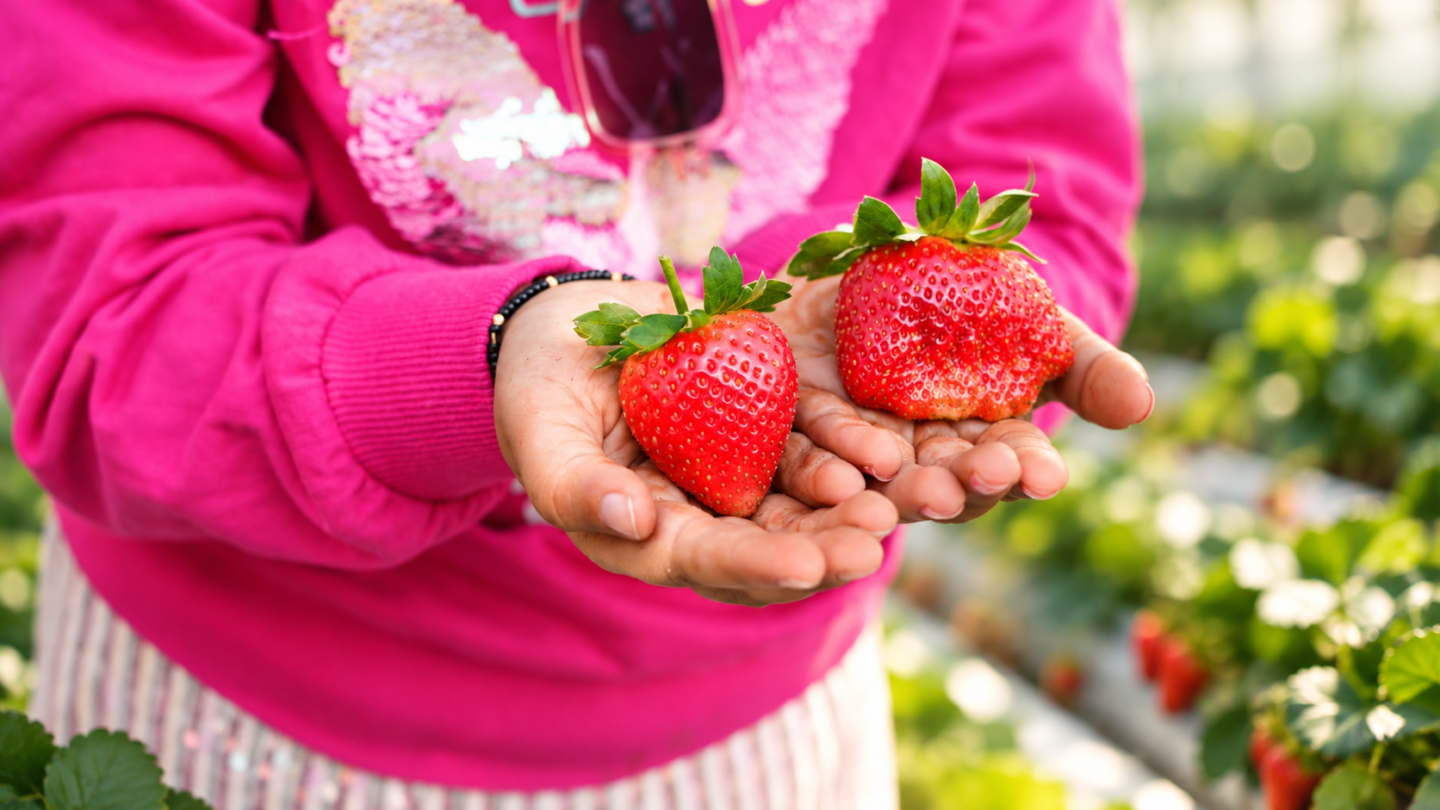
Looking for a strawberry farm Hyderabad can call its own? The clearest answer today is Dhanuka Farms, a precision-cultivation estate at Dasarlapalle, about 45 km from the city. Here, strawberries grow in climate-controlled polyhouses rather than open fields. Farm visits are pre-booked and timed to the harvest calendar, and new strawberry batches begin in November.
That answer would have sounded impossible a decade ago. The strawberry is one of the world’s most loved fruits, with global production crossing 10.7 million tonnes in 2024, per FAOSTAT data compiled by Wikipedia. Yet in India, the fruit has long belonged to one hill belt. The Mahabaleshwar-Panchgani region of Maharashtra still grows roughly 85% of the country’s strawberries and holds a GI tag earned in 2010, according to the Mahabaleshwar strawberry record. For Hyderabad, that meant strawberries always arrived from hundreds of kilometres away.
Controlled-environment farming has quietly changed that equation. A modern strawberry farm near Hyderabad no longer needs a hill station’s climate. It needs engineering. This guide covers where to find one, what you will see there, how strawberries actually grow, when to visit, and how to plan the trip.
Are there strawberry farms near Hyderabad?
Yes, though the answer needs context. Hyderabad sits on the Deccan plateau. Summers are hot, and even winters stay mild rather than cold. The city has never been a traditional strawberry belt, and large open-field strawberry farms in Hyderabad remain rare.
But strawberry plants respond to conditions, not to maps. Give the plant a cool root zone, steady moisture, filtered light, and protection from harsh afternoon heat, and it will fruit outside the hills. Protected cultivation creates exactly those conditions. Polyhouses regulate temperature and humidity. Raised growing channels keep roots healthy. Drip lines deliver measured water and nutrition.
That is what makes strawberry farming in Hyderabad genuinely viable now. A new generation of precision farms around the city is growing berries that once travelled hundreds of kilometres to reach local shelves. Dhanuka Farms, at Dasarlapalle in Telangana, is the clearest example. The estate grows strawberries, blueberries, raspberries, and the rare pineberry inside climate-controlled polyhouses, releasing fruit in small batches only at peak maturity.
Where exactly is Dhanuka Farms, and how far is it from Hyderabad?
Dhanuka Farms is located at Dasarlapalle in Telangana, roughly 45 km from Hyderabad. For most of the city, the drive takes about an hour to ninety minutes by road, depending on where you start.
The journey is simple to picture:
- Hyderabad — start from the city and head out toward the open countryside.
- Dasarlapalle — reach the estate, where polyhouse structures replace the usual open-field farmscape.
- The strawberry experience — step inside a controlled growing environment where premium berries are cultivated with measured precision.
This is not a picnic-style farm with fruit strewn across open acres. It is a working precision estate. Visits are scheduled, pre-booked, and aligned to what the farm is growing at that moment. The estate’s polyhouse tours run when cultivation allows, and seasonal experiences open around harvest cycles. You can apply through the Dhanuka Farms farm experience page or reach the team on WhatsApp.
What makes a visit to a strawberry farm special?
A supermarket box hides the entire story of the fruit. A farm visit reveals it. On a working strawberry farm, visitors can see things that no store shelf can show:
- How strawberry plants actually grow — low, leafy crowns set in raised channels rather than flat soil.
- Where the fruit develops — each berry begins as the centre of a small white flower.
- How a flower becomes fruit — after pollination, the flower’s heart swells and slowly turns into the berry.
- How ripeness is judged — growers look for full, even colour across the whole berry before harvest.
- How berries are harvested — each strawberry is picked by hand, individually, at exactly the right stage.
- How conditions shape flavour — temperature, light, and water all show up in the final taste.
- How technology is changing agriculture — sensors, climate control, and drip systems doing work that guesswork once did.
There is also quiet wonder in the details. A single strawberry carries roughly 200 tiny achenes, the seed-like dots on its skin, making it one of the few fruits that wear their seeds on the outside. Children notice these things. So do food lovers, photographers, and anyone curious about where their food really begins.
How are strawberries grown in modern farms?
Modern strawberry cultivation follows a clear, repeatable sequence. Here is how the process works on a precision farm:
- Healthy plants are established. Young, disease-free strawberry plants are introduced into raised channels filled with a clean growing medium. Strong beginnings decide the season’s quality.
- Growing conditions are calibrated. Water, nutrients, temperature, light, and humidity are managed actively. Drip lines deliver measured nutrition straight to the root zone, where the plant actually feeds.
- Flowers develop. Each plant produces clusters of white, five-petaled blossoms. Once pollinated, the centre of every flower begins its slow transformation into fruit.
- Fruit develops and ripens. The berry passes through visible stages, from hard green to pale white to blush pink to deep, glossy red. The full journey from flower to ripe fruit usually takes several weeks.
- Harvesting happens at peak colour. Strawberries do not ripen further after picking. They are harvested fully coloured, by hand, one berry at a time.
That last fact matters more than most people realise. Because a strawberry cannot ripen after harvest, every stage below is visible on the plant right up to the moment of picking:
| Stage | What you see | What it means |
|---|---|---|
| Flower | Small white blossom with a yellow centre | A future berry has begun |
| Green fruit | Hard, small, green berry forming | Fruit is developing; not ready |
| Turning fruit | White or blush-pink berry | Colour and sugars are building |
| Ripe fruit | Deep, even red with a natural gloss | Ready for hand harvest |
What is hydroponic strawberry farming?
Hydroponic strawberry farming is a method of growing strawberries without traditional soil, using a controlled system that delivers water and dissolved nutrients directly to the plant’s root zone.
The reason farms adopt it comes down to control:
- Measured nutrition. The plant receives an exact nutrient recipe rather than whatever the local soil happens to offer.
- Water efficiency. Recirculating soilless systems can use up to 90% less water than conventional soil cultivation, according to a review of hydroponic farming published by IntechOpen.
- Fewer soil-borne problems. Removing soil removes many of the diseases and pests that live in it.
- Cleaner fruit. Raised channels keep berries off the ground, away from splashes and rot.
In a conventional field, soil buffers everything and varies everywhere. In a soilless system, roots get a steady balance of moisture, oxygen, and nutrition in an inert medium such as cocopeat. Dhanuka Farms describes its own approach as precision cultivation inside climate-controlled polyhouses. Whether a given crop runs on a hydroponic circuit or an inert substrate, the principle is the same: precision at the root zone.
When is strawberry season in Hyderabad?
Strawberry season near Hyderabad runs through the cooler months. At Dhanuka Farms, the strawberry cycle begins in November, with fruit released in small, demand-driven batches as each lot reaches maturity. Because timing shifts with real growing conditions, visitors should confirm current availability with the farm before planning a trip.
Strawberries are seasonal everywhere in India. The winter months do the heavy lifting across the country’s growing belts, which is why hill-grown fruit floods city markets between December and March. A controlled-environment farm follows the same rhythm, simply with far more precision. The estate lists its next strawberry batch from November 2026 on its seasonal produce page, and releases are announced batch by batch rather than all at once.
The practical takeaway is simple. Do not plan a strawberry visit on assumption. Check the farm’s current availability, then plan the drive.
What can you see at a strawberry farm?
A visit answers the one practical question every curious visitor has: what will I actually see? On a modern strawberry farm, the sights include:
- Strawberry plants up close — lush green crowns growing in orderly raised channels, at a comfortable viewing height.
- Strawberry flowers — delicate white blossoms, each one a berry in waiting.
- Developing fruit — berries at every stage at once, from hard green to soft blush.
- Ripe strawberries — deep red, glossy fruit waiting for hand picking at peak maturity.
- The growing infrastructure — polyhouse skins, shade systems, drip lines, and climate sensors. The invisible precision becomes visible.
It is part garden, part laboratory. That combination is exactly what makes a precision estate worth the drive.
Why visit a strawberry farm instead of just buying strawberries?
Here is the heart of it: a supermarket tells you what a strawberry costs. A farm shows you what it takes to grow one.
Buying fruit is a transaction. Visiting a farm is a connection. You learn why ripeness matters, especially for a fruit that never sweetens after harvest. You see the months of calibration behind a single punnet. You understand why a berry picked at peak colour yesterday tastes nothing like one picked early for a long truck journey.
That freshness gap is precisely what a farm release model protects. Dhanuka Farms builds its harvests around a roughly 36-hour window from picking to release, so fruit reaches people at the maturity it was grown for. A visit turns that abstract idea into something you can see, smell, and taste.
Is a strawberry farm visit good for families?
Yes, and unusually so. A working berry farm is one of the few outings that entertains children and educates them at the same time:
- Children see food differently. Watching a flower become a fruit rewires how young minds think about what they eat.
- It is real time outdoors. Fresh air, open countryside, and gentle walking instead of screens.
- It opens the agriculture conversation. Families see firsthand how technology and care combine to grow food.
- Photography comes naturally. Rows of plants and bright berries make easy, joyful pictures, as the next section covers.
A couple of honest notes. Visits at Dhanuka Farms are structured and pre-booked, not walk-in. Check with the team about age-appropriate sessions and what your visit includes when you book. And remember that this is a working farm: visitor zones keep both guests and plants safe.
Is a strawberry farm near Hyderabad good for photography?
Surprisingly good. Photographers find ready-made compositions everywhere on a precision berry estate:
- Rows and geometry — receding lines of raised channels inside the polyhouse.
- Macro subjects — white blossoms, tiny achenes, dew on leaves.
- Colour stories — the green-to-red progression of ripening fruit in a single frame.
- Diffused light — polyhouse panels soften harsh sun into a natural softbox through the day.
Morning sessions are best for calm conditions and gentle light. Do ask the team before photographing staff closely or using professional gear, and tag the farm when you share. Strawberry farm photography near Hyderabad is still a rare niche, which is exactly why it performs well on social feeds.
What should you know before visiting a strawberry farm?
A little planning makes the visit far better. Run through this checklist before you set out:
- Check the season. Strawberries are seasonal. At Dhanuka Farms, batches begin in November and release in stages.
- Confirm farm access. This is a working estate. Visits are pre-booked and scheduled, not walk-in.
- Check fruit availability. Harvests move in batches. What is ripe this week may be picked clean the next.
- Follow farm guidelines. Stay within visitor zones and respect the growing areas and infrastructure.
- Dress for the farm. Closed shoes and a hat help. Polyhouses can turn warm by afternoon.
- Do not pick fruit unless invited. Picking happens only in sessions the farm specifically opens. Otherwise, admire with your eyes.
- Confirm before you travel. Re-check your booking slot and timing with the team on the day.
Why is Dhanuka Farms different?
Several things set the estate apart from a conventional farm outing:
Modern farming, genuinely practised. Climate-controlled polyhouses, measured irrigation, and monitored nutrition are the daily reality here, not marketing language.
A premium berry portfolio. Alongside strawberries, the estate grows blueberries, raspberries, and pineberries, often called India’s rarest berry. Few estates anywhere in the country attempt this lineup.
Quality that is measured, not assumed. Sweetness is checked with Brix readings before fruit is ever released. The estate’s philosophy is refreshingly blunt: “Never for logistics. Never for scale. Only at the right moment.”
A genuine connection to farming. Harvest-timed visits exist so people can see cultivation up close. Dhanuka Farms treats curiosity about food as something worth rewarding with access.
Strawberry farm Hyderabad: what should you expect at Dhanuka Farms?
Here is the practical visitor picture, gathered in one place:
| Planning detail | What to know |
|---|---|
| Location | Dasarlapalle, Telangana — about 45 km from Hyderabad |
| Farm type | Climate-controlled polyhouse cultivation (protected precision farming) |
| Strawberry season | From November; fruit released in small, demand-driven batches |
| Other berries | Blueberries, raspberries, and pineberries, grown seasonally |
| Strawberry picking | Seasonal sessions are announced by the farm — see how strawberry picking near Hyderabad became possible, and confirm the current status when booking |
| Visitor access | Pre-booked farm experiences and polyhouse tours, timed to harvest cycles |
| Timings and fees | Shared directly by the team at the time of booking |
| How to book | Through the farm experience page or the farm’s WhatsApp channel |
One honest rule applies to everything above: confirm the specifics before you travel. Seasons shift, batches sell through, and the farm schedules visits around what the plants are actually doing.
Frequently Asked Questions
Where can I find a strawberry farm near Hyderabad?
Is there a strawberry farm in Hyderabad?
When is strawberry season near Hyderabad?
Can you visit a strawberry farm near Hyderabad?
Can you pick strawberries at a farm near Hyderabad?
How are strawberries grown in Hyderabad?
Are strawberries grown hydroponically in Hyderabad?
What is the best time to visit a strawberry farm?
Are strawberry farms suitable for children?
Where can I buy fresh strawberries near Hyderabad?
